
NOTE: If you have received this via email, you may find it easier to read the confabulannotations online by clicking on the title above.
Previously on my confabulannotations of Sir Arthur Conan Doyle’s Sherlock Holmes mystery, The Hound of the Baskervilles: Sir Henry finally arrived

And now, the story continues…
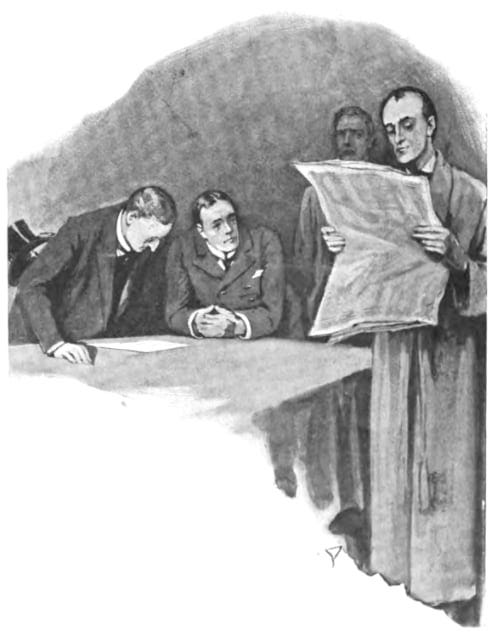
“Who knew that you were going to the Northumberland Hotel?” asked Holmes, glancing keenly1 across at our visitor.
“No one could have known. We only decided after I met Dr. Mortimer2.”
“But Dr. Mortimer was no doubt already stopping there?”
“No, I had been staying with a friend,” said the doctor.
“There was no possible indication3 that we intended to go to this hotel.”
“Hum!4 Someone seems to be very deeply interested in your movements.” Out of the envelope he took a half-sheet of foolscap paper folded into four5. This he opened and spread flat upon the table. Across the middle of it a single sentence had been formed by the expedient of pasting printed words6 upon it. It ran:
As you value your life or your reason7 keep away from the moor.
The word “moor” only was printed in ink.
“Now,” said Sir Henry Baskerville, “perhaps you will tell me, Mr. Holmes, what in thunder8 is the meaning of that, and who it is that takes so much interest in my affairs?”
“What do you make of it, Dr. Mortimer? You must allow that there is nothing supernatural about this9, at any rate?”
“No, sir, but it might very well come from someone who was convinced that the business is supernatural.”
“What business?” asked Sir Henry sharply. “It seems to me that all you gentlemen know a great deal more than I do about my own affairs10.”

‘Keen’ glances were frowned upon in polite society as indicators of suggestive familiarity. The usage of it here would have earned Conan Doyle a formal reprimand from the London Smut and Associated Indecency Tribunal - not, it should be noted, his first.
Decisions made after meeting a doctor were considered legally binding in ways that decisions made before meeting one were not, a state of affairs which did nothing for public health.
Holmes famously had multiple classifications of indications, that ran from the impossible through the improbable, the possible, the somewhat confusing, the probable, the evident, and, at the apex, the obvious. This exchange in which there is little indication of who is speaking at any particular point would have been classified as ‘somewhat confusing’.
It fell to Watson, as in so many things, to catalogue Holmes’ non-verbal utterances across the canon, ranging from the mild ‘Hum!’ through the intrigued ‘Ha!’ to the rarely deployed ‘Yowsers!’, which indicated either a significant breakthrough, the possibility of adultery, or the presence of a large spider.
Topologists of the time had formally proven that four (4) was the maximum number of folds possible in a single sheet of paper, mostly because it was, and remains, such a deeply unrewarding field that nobody had thought to try for any more.
Conan Doyle claimed on numerous occasions that this idea came to him in a dream in which Thomas Hardy was cutting words out of his manuscripts and pasting them into sentences that Sir Arthur would only describe (begrudgingly) as ‘more rurally melancholic’.
‘Your reason or your life’ was a common robbery ultimatum from the more philosophically inclined highwaymen of the era.
‘What in thunder’ was a specifically Canadian expletive, derived from when a startled colonist first heard the deafening roar of the Niagara Falls. This utterance from Sir Henry is widely believed to be its first documented usage in an English drawing room.
In the 1903 Flemish translation, Holmes’ gentle ribbing here was mistakenly rendered as a formal accusation, resulting in Mortimer challenging Holmes to a duel that does not appear in any other edition. In the 1904 Flemish translation, the dialogue was replaced by a proverb about geese.
Yowsers!
“But Dr. Mortimer was no doubt already stopping there?”
“No, I had been staying with a friend,” said the doctor.
“There was no possible indication³ that we intended to go to this hotel.”
I never thought about this but this does seem a tad confusing, hehe:)