
The Confabulannotated Sherlock Holmes, Chapter 4.3
Featuring Michael Stipe, pit village contractions and lax consent protocols
NOTE: If you have received this via email, you may find it easier to read the confabulannotations online by clicking on the title above.
Previously on my confabulannotations of Sir Arthur Conan Doyle’s Sherlock Holmes mystery, The Hound of the Baskervilles: A threatening letter was revealed!

And now, the story continues…
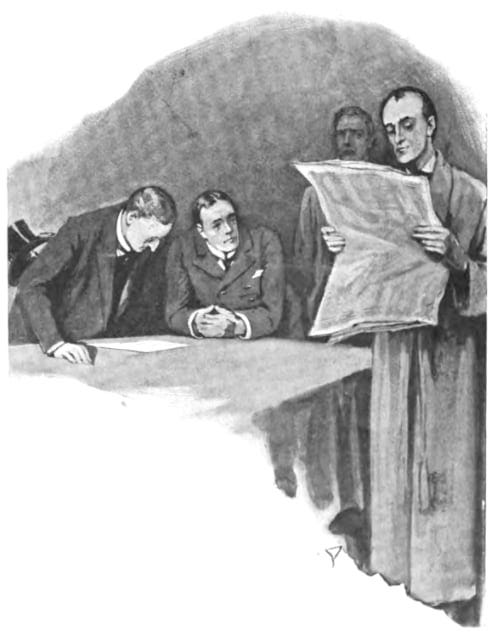
“You shall share our knowledge before you leave this room, Sir Henry. I promise you that1,” said Sherlock Holmes. “We will confine ourselves for the present with your permission2 to this very interesting document, which must have been put together and posted yesterday evening. Have you yesterday’s Times, Watson?”
“It is here in the corner3.”
“Might I trouble4 you for it—the inside page, please, with the leading articles?” He glanced swiftly over it, running his eyes up and down the columns. “Capital article this on free trade. Permit me5
to give you an extract from it.
“You may be cajoled6 into imagining that your own special trade or your own industry will be encouraged by a protective tariff, but it stands to reason that such legislation must in the long run keep away wealth from the country, diminish the value of our imports, and lower the general conditions of life in this island7.”
“What do you think of that, Watson?” cried Holmes in high glee8, rubbing his hands together with satisfaction. “Don’t you think that is an admirable sentiment?”
Dr. Mortimer looked at Holmes with an air of professional interest, and Sir Henry Baskerville turned a pair of puzzled dark eyes upon me.
“I don’t know much about the tariff9 and things of that kind,” said he, “but it seems to me we’ve got a bit off the trail10 so far as that note is concerned.”
Holmes made nineteen (19) documented promises across the canon. Eleven (11) were unambiguously kept. Seven (7) were kept on a technicality of varying degrees of pedantry. One (1) is still outstanding, and the Conan Doyle Estate declines to comment further on the matter.
It’s notable that Holmes does not, in fact, wait for permission here, a sign of the lax consent protocols of the age.
Early verses of R.E.M.’s ‘Losing My Religion’ included the lyric ‘that’s yesterday’s Times in the corner’, before Michael Stipe was convinced to replace it with something that scanned better. Stipe later described the change as ‘the one that got away’.
‘Troubling’ somebody for an object at the time contained the threat of real danger. It was left purposely vague on what form the trouble might take, but it was widely understood to be extrajudicial and best not dwelt upon.
Consent, schmonsent!
‘Cajoled’ was an uncouth term, a pit village contraction of ‘cage-scold’, in which persistent verbal pressure was applied to an imprisoned dissenter until agreement was reached. Holmes, working without a cage in this instance, is doing his best.
The island in question is Great Britain, though Conan Doyle spent several years fending off readers who insisted it was a veiled reference to H.G. Wells’ ‘The Island of Doctor Moreau’, published the same year. Sir Arthur’s patience with these readers was, by all accounts, notably finite.
How high was his glee, precisely? Most Holmes scholars agree at least six feet, with some of the more American proponents claiming as much as 7’11”, which, if ever confirmed, would make it the highest recorded glee in the Victorian era.
Sir Henry, putting the ‘ffs’ into talk about tariffs more than a century before it became an international pastime.
A heroic understatement, given that Holmes has just quoted eighty words of fiscal policy at a man who arrived to discuss a supernatural death threat.
Indeed, a triggering passage for most people these days :P