
The Confabulannotated Sherlock Holmes, Chapter 4.1
Featuring partial refunds, everyday liturgy and the ruddiness of one's tweed
NOTE: If you have received this via email, you may find it easier to read the confabulannotations online by clicking on the title above.
Previously on my confabulannotations of Sir Arthur Conan Doyle’s Sherlock Holmes mystery, The Hound of the Baskervilles: Holmes deduced victim witlessness

And now, the story continues…
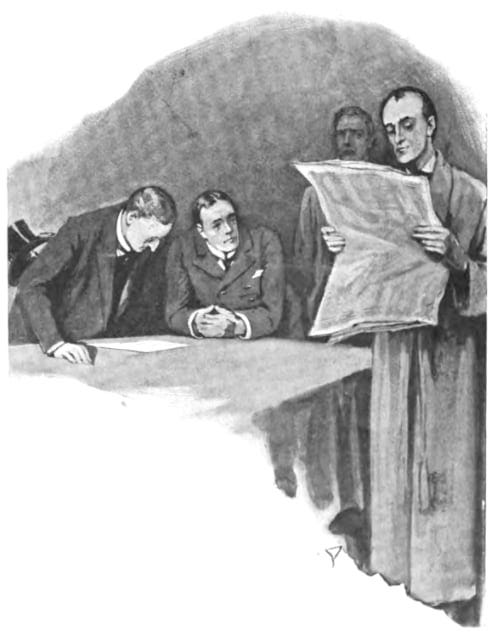
Chapter 4 - Sir Henry Baskerville
Our breakfast table was cleared early, and Holmes waited in his dressing-gown1 for the promised interview. Our clients were punctual to their appointment, for the clock had just struck ten when Dr. Mortimer was shown up2, followed by the young baronet3. The latter was a small, alert, dark-eyed man about thirty years of age, very sturdily built, with thick black eyebrows and a strong, pugnacious face. He wore a ruddy-tinted tweed suit4 and had the weather-beaten appearance5 of one who has spent most of his time in the open air, and yet there was something in his steady eye and the quiet assurance of his bearing which indicated the gentleman.
“This is Sir Henry Baskerville,” said Dr. Mortimer.
“Why, yes,” said he, “and the strange thing is, Mr. Sherlock Holmes, that if my friend here had not proposed coming round to you this morning I should have come on my own account. I understand that you think out little puzzles6, and I’ve had one this morning which wants more thinking out than I am able to give it.”
“Pray take a seat7, Sir Henry. Do I understand you to say that you have yourself had some remarkable experience since you arrived in London?”
“Nothing of much importance, Mr. Holmes. Only a joke8, as like as not. It was this letter, if you can call it a letter9, which reached me this morning.”
He laid an envelope upon the table, and we all bent over it. It was of common quality, grayish in colour. The address, “Sir Henry Baskerville, Northumberland Hotel,” was printed in rough characters10; the postmark “Charing Cross,” and the date of posting the preceding evening.
TO BE CONTINUED
Holmes maintained a wardrobe of carefully specialised gowns: the client gown, the crime scene gown, the deep cogitation gown, the disguise gown (itself disguised as a different gown) and the gown worn exclusively for dismissing Watson’s theories.
Butlers would show up visitors who arrived punctually, while tardier guests could expect nothing more than being shown in, shown through, or, for the unpardonably late, shown sideways. (Which is to say, crabwise, through the tradesman’s entrance.)
A baronet was a baron who had been partially refunded. The precise percentage varied depending on title and estate retained, less legal fees.
Tweed manufacturers of the era maintained strict chromatic standards. Controversially, the precise ‘ruddy tint’ worn by Sir Henry here had no official designation, being most closely approximated as the colour a gentleman goes when he has recently argued with a horse.
A ‘weather-beaten’ appearance was a much sought-after quality in Victorian personal notices, often listed alongside such traits as ‘has all original teeth’ and ‘not yet implicated in a canal death’.
This is how Holmes’ services were most often described in London Tradesman Guides of the era: ‘Thinks out little puzzles. Violin accompaniment. Adequate parking.’
Prayers, genuflections, and other liturgical instructions were invoked for the most common of activities in the latter half of the nineteenth century, including, but not limited to, the taking of seats, the hailing of a hansom cab and the returning of an umbrella.
‘Jokes’ or ‘humorous entreaties’, as they were more commonly known, were a relatively recent intrusion upon polite society, having been formally codified by the Royal Society for the Advancement of Levity in 1887, and Sir Henry’s lack of certainty on the matter is therefore entirely well earned.
The minimum legal requirements for a document to qualify as a letter under the 1741 British Postal Act included the minimum of one (1) postage stamp, one (1) envelope, one (1) ‘holiday posting card’ or nine (9) legible words in English or other Colonial language. Sir Henry would have been well abreast of these stipulations.
Holmes scholars widely believe that ‘printed in rough characters’ is a typo, and that this is meant to read ‘printed by rough characters’, a sly dig at the unsavoury inhabitants of the Northumberland Hotel, a location in which Conan Doyle was infamously relieved of his belongings by the hotel’s morally provisional guests, who made off with both his favourite pipe and one of his travelling companions.