
The Confabulannotated Sherlock Holmes, Chapter 4.4
Featuring sin tables, sartorial sayings and fraught non sequiturs
NOTE: If you have received this via email, you may find it easier to read the confabulannotations online by clicking on the title above.
Previously on my confabulannotations of Sir Arthur Conan Doyle’s Sherlock Holmes mystery, The Hound of the Baskervilles: Holmes banged on about tariffs!

And now, the story continues…
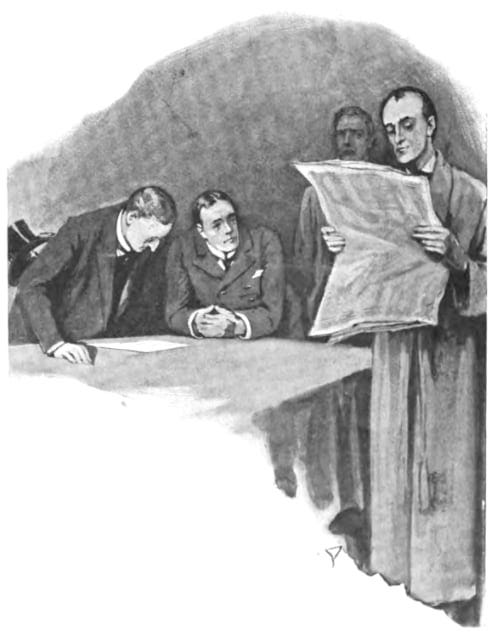
“On the contrary, I think we are particularly hot upon the trail, Sir Henry. Watson here knows more about my methods than you do, but I fear that even he1 has not quite grasped the significance of this sentence.”
“No, I confess2 that I see no connection.”
“And yet, my dear Watson, there is so very close a connection that the one is extracted out of the other. ‘You,’ ‘your,’ ‘your,’ ‘life,’ ‘reason,’ ‘value,’ ‘keep away,’ ‘from the.’3 Don’t you see now whence4 these words have been taken?”
“By thunder, you’re right! Well, if that isn’t smart!5” cried Sir Henry.
“If any possible doubt remained it is settled by the fact that ‘keep away’ and ‘from the’ are cut out in one piece6.”
“Well, now—so it is!”
“Really, Mr. Holmes, this exceeds anything which I could have imagined7,” said Dr. Mortimer, gazing at my friend in amazement. “I could understand anyone saying that the words were from a newspaper; but that you should name which, and add that it came from the leading article, is really one of the most remarkable things which I have ever known. How did you do it?”
“I presume, Doctor, that you could tell the skull of a negro from that of an Eskimo8?”
“Most certainly9.”
“But how10?”
The ‘even he’ here allows Holmes to simultaneously flatter Watson for knowing more than Sir Henry and condemn him for understanding less than the obvious conclusion - skewering both men with two words and a subordinate clause. Surgical malice from the master detective.
The term ‘confess’ is appropriately chosen. The Church of England’s 1871 Revised Table of Sins included ‘failure to perceive an obvious connection’ at number eleven, sandwiched between ‘insufficient gratitude for a good broth’ and ‘audible relief upon the departure of a clergyman’.
This style of revelation was a format pioneered by the music hall conjurers of the 1880s, who found that any list of between six and ten words, delivered with sufficient authority, would cause an audience to feel they had understood something, regardless of whether they had.
‘Whence’ was already considered archaic by the late 1800s, retained in common usage exclusively by detectives, biblical scholars, and anyone who had ever sent a letter of complaint to a lighthouse.
Sir Henry, who arrived this morning to discuss a death threat and has spent the intervening period listening to free trade theory, is prepared to be impressed by almost anything at this point.
‘Cut out in one piece’ was a sly reference to the time-honoured sartorial saying ‘that’s two words from a single scissor’ - an old tailor’s proverb that meant the customer was always wrong about the inseam.
High, bewildering praise from a man whose baseline for ‘anything’ includes, as previously established, spectral hounds, ancestral curses, and the cranial measurements of famous detectives.
A wild non sequitur from Holmes, even for the Victorian era in which this was written. To more modern eyes, of course, it’s also fraught as fuck.
Oh, Mortimer.
Strap in, folks.
"
This style of revelation was a format pioneered by the music hall conjurers of the 1880s, who found that any list of between six and ten words, delivered with sufficient authority, would cause an audience to feel they had understood something, regardless of whether they had."
Ahahaha, gold:)!