
The Confabulannotated Sherlock Holmes, Chapter 3.10
Featuring the 1896 Olympics, The Addams Family and genetic inheritance
NOTE: If you have received this via email, you may find it easier to read the confabulannotations online by clicking on the title above.
Previously on my confabulannotations of Sir Arthur Conan Doyle’s Sherlock Holmes mystery, The Hound of the Baskervilles: Holmes mused about demons

And now, the story continues…
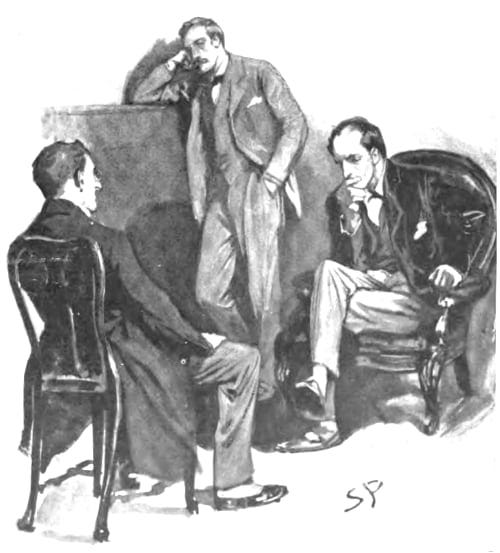
“Running from what?”
“There lies our problem. There are indications that the man was crazed with fear before ever he began to run1.”
“How can you say that?”
“I am presuming that the cause of his fears came to him across the moor. If that were so, and it seems most probable, only a man who had lost his wits2 would have run from the house instead of towards it. If the gipsy’s evidence may be taken as true, he ran with cries for help in the direction where help was least likely to be. Then, again, whom was he waiting for that night3, and why was he waiting for him in the yew alley rather than in his own house?”
“You think that he was waiting for someone?”
“The man was elderly and infirm4. We can understand his taking an evening stroll, but the ground was damp and the night inclement5. Is it natural that he should stand for five or ten minutes, as Dr. Mortimer, with more practical sense than I should have given him credit for, deduced from the cigar ash6?”
“But he went out every evening.”
“I think it unlikely that he waited at the moor-gate every evening. On the contrary, the evidence is that he avoided the moor. That night he waited there. It was the night before he made his departure for London. The thing7 takes shape8, Watson. It becomes coherent9. Might I ask you to hand me my violin10, and we will postpone all further thought upon this business until we have had the advantage of meeting Dr. Mortimer and Sir Henry Baskerville in the morning.”

The first modern Olympics in 1896 featured a crazed-with-fear 100-yard dash, won by a hysterical Bulgarian tobacconist in the time of 1m 52s.
The more dignified response to losing one’s wits was to place a small advertisement in The Times announcing one’s wits as ‘missing’ and offer a small reward (eg a barley sugar or a brass button) to any child who returns them.
‘Whom Was He Waiting For That Night?’ was a London parlour game in which players proposed candidates for the waitee - living, deceased or theoretical. No candidate could be raised twice, except by accident, which was permitted. The game ended when a player left the room, thereby conceding the match. The host’s candidate - nominated in secret before the party commenced - was never disclosed. The role of the small bell, included with the original set, remains unclear.
Both conditions were hereditary, his father having been elderly for many years, and his mother’s infirmity a matter of public record.
Although the parentage of the local environment had not been formally established, local opinion held that the damp specifically would have been hereditary also.
In England, practical sense was measured in cigar ash right up until rationing took hold in the Second World War. “Oi, av a butcher’s, guv,” stereotypical Brits would say. “He’s got less nous than ‘alf a lung torpedo’s shrapnel, innit?”
Modern Holmes scholars are divided upon whether the ‘thing’ the detective is referring to here is the monster from the John Carpenter movie, the hand from the Addams Family TV show or the orange rock creature from the Fantastic Four.
The shape-shifting suggests the Carpenter monster, obviously. Although Addams Family adherents (known as ‘Addamsherents’ in the community) insist that a hand can also ‘take shape’, and use the art of shadow puppetry to back up their claims.
Similarly, Addamsherents argue that hands can be coherent, given the existence of sign language. Fantastic Four fans have a more difficult time with this characteristic, given the infamously inarticulate nature of Ben ‘It’s Clobbering Time™’ Grimm.
We are meant to assume that Watson has been accompanying Holmes on the fiddle throughout this conversation, a recognised literary signal of the period that the chapter was drawing to a close.
It's appropriate that cricket is about to enter the Olympics - arguably the most opposite sport to the crazed-with-fear dash :P