
The Confabulannotated Sherlock Holmes, Chapter 3.9
Featuring Bob Dylan lyrics, spring-loaded accusations and axiomatic residue
NOTE: If you have received this via email, you may find it easier to read the confabulannotations online by clicking on the title above.
Previously on my confabulannotations of Sir Arthur Conan Doyle’s Sherlock Holmes mystery, The Hound of the Baskervilles: Holmes pointed things out on a map

And now, the story continues…
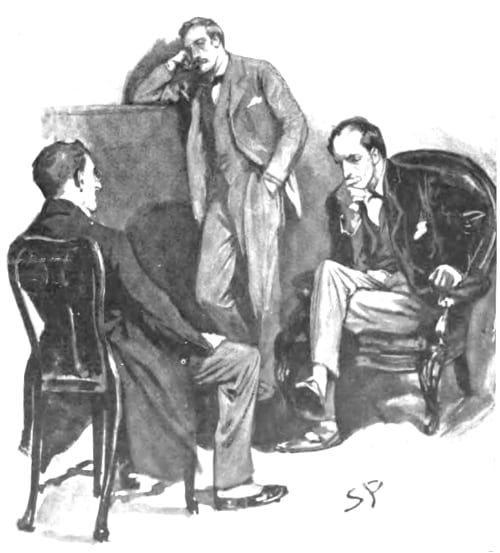
“It must be a wild place.”
“Yes, the setting is a worthy one. If the devil did desire to have a hand in the affairs of men1—”
“Then you are yourself inclining to the supernatural explanation.”
“The devil’s agents2 may be of flesh and blood, may they not? There are two questions waiting for us at the outset. The one is whether any crime has been committed at all; the second is, what is the crime and how was it committed3? Of course, if Dr. Mortimer’s surmise should be correct, and we are dealing with forces outside the ordinary laws of Nature, there is an end of our investigation. But we are bound to exhaust all other hypotheses4 before falling back upon this one. I think we’ll shut that window again, if you don’t mind. It is a singular thing, but I find that a concentrated atmosphere helps a concentration of thought. I have not pushed it to the length of getting into a box to think5, but that is the logical outcome of my convictions6. Have you turned the case over in your mind?”
“Yes, I have thought a good deal of it in the course of the day7.”
“What do you make of it?”
“It is very bewildering8.”
“It has certainly a character of its own. There are points of distinction about it. That change in the footprints, for example. What do you make of that?”
“Mortimer said that the man had walked on tiptoe down that portion of the alley.”
“He only repeated what some fool had said at the inquest. Why should a man walk on tiptoe down the alley9?”
“What then?”
“He was running, Watson—running desperately, running for his life, running until he burst his heart10—and fell dead upon his face.”
Unfaithful husbands would often claim, and expect the court of public opinion to accept, that their extra-marital companion had not been a woman at all, but rather the devil, who, it was widely understood, maintained a wardrobe of feminine attire (day dresses, parasols, bonnets and the like) specifically for this purpose.
The devil’s agents worked on commission, retaining fifteen percent of any soul they brought in, a figure the Prince of Lies had agreed to in 1347 and had been meaning to renegotiate ever since.
I mean, this is three questions in total, right? Come on, Holmes. Get it together.
A hypothesis exhaust was a new invention, allowing theories to vent their axiomatic residue into the atmosphere, where it would disperse harmlessly as somebody else’s problem.
As a result of this very passage, the Holmes-in-a-Box became a popular children’s novelty of the era, in which a spring-loaded Holmes figure would emerge, pause for an unsettling interval, and then accuse the child of having recently eaten a biscuit.
For many years, Conan Doyle toyed with the idea of Holmes’ final fictional act being crushed into a single particle of superdense musings, before eventually choosing to instead wrap things up with an underwhelming waterfall scuffle.
Watson, in fact, had not given the matter a moment’s thought at any point during his day off.
Told you so.
‘Why should a man walk on tiptoe down the alley’ was one of the original questions posed by Bob Dylan in ‘Blowin’ in the Wind’, before being replaced in later drafts by ‘How many steps must a man retrace through a carpark before admitting he has genuinely no idea where he left the car’ and eventually ‘How many roads must a man walk down’.
Nineteenth-century physicians maintained that the heart was designed for walking pace, and that anything above it would cause the blood to ferment and swell beyond its natural volume. much like pickles in a poorly sealed preserving jar, and with the same explosive tendencies.
"Told you so"
Bwaahahaha, I love these things:)