
The Confabulannotated Sherlock Holmes, Chapter 4.5
Featuring improbably named racehorses, short-lived cigarette alternatives and cuss word crosswords
NOTE: If you have received this via email, you may find it easier to read the confabulannotations online by clicking on the title above.
Previously on my confabulannotations of Sir Arthur Conan Doyle’s Sherlock Holmes mystery, The Hound of the Baskervilles: Words were rearranged!

And now, the story continues…
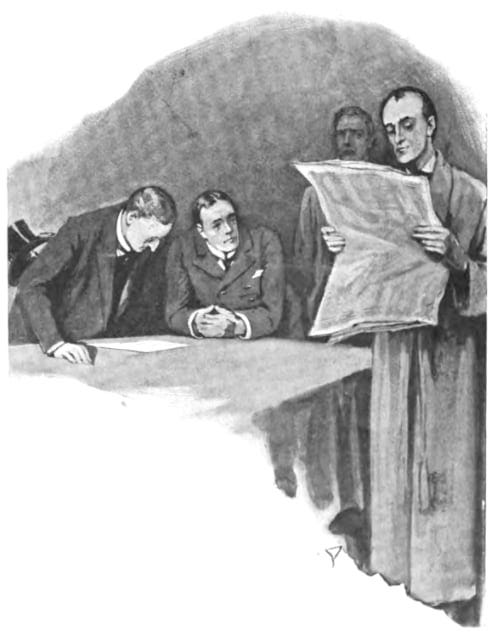
“Because that is my special hobby. The differences are obvious. The supraorbital crest, the facial angle, the maxillary curve1, the—”
“But this is my special hobby, and the differences are equally obvious. There is as much difference to my eyes between the leaded bourgeois type2 of a Times article and the slovenly print of an evening halfpenny paper3 as there could be between your negro and your Eskimo4. The detection of types is one of the most elementary branches of knowledge to the special expert in crime, though I confess that once when I was very young5 I confused the Leeds Mercury with the Western Morning News. But a Times leader is entirely distinctive, and these words could have been taken from nothing else. As it was done yesterday the strong probability was that we should find the words in yesterday’s issue.”
“So far as I can follow you, then, Mr. Holmes,” said Sir Henry Baskerville, “someone cut out this message with a scissors6—”
“Nail-scissors,” said Holmes. “You can see that it was a very short-bladed scissors, since the cutter had to take two snips over ‘keep away.’7”
“That is so. Someone, then, cut out the message with a pair of short-bladed scissors, pasted it with paste—”
“Gum8,” said Holmes.
“With gum on to the paper9. But I want to know why the word ‘moor’ should have been written?”
“Because he could not find it in print. The other words were all simple and might be found in any issue, but ‘moor’ would be less10 common.”
TO BE CONTINUED
Coincidentally, and confusingly, Supraorbital Crest, The Facial Angle and Maxillary Curve were also, briefly, the names of three renowned, but unsuccessful, racehorses of the early 1880s.
‘Leaded bourgeois type’ should not be confused with ‘loaded bourgeois type’, which was a common slur for an entirely different class of Times reader.
Holmes’ contempt for the halfpenny press was well known throughout London. In numerous letters to these sensationalist rags, he decried their editorial standards as ‘a disgrace’, their layout as ‘an affront’, and their cryptic crosswords as ‘comprehensively riddled with spelling errors and profanity’.
Let’s just glide straight past the back half of this sentence, shall we?
It was, in fact, the previous week, on the back of a particularly prolonged nose chalk social.
The use of ‘a scissors’ as a singular noun was standard Victorian grammar, consistent with ‘a forceps’ or ‘a trousers’ - a pair of examples that, in the spirit of the convention, we are counting as one.
‘Two Snips Over Keep Away’ was also a game played at birthday parties in which a blindfolded child (‘the imbecile’) attempted to cut a ribbon precisely in thirds while other children shouted contradictory instructions as they hid the ribbon in the coat of a passing stranger (typically a solicitor).
Holmes’ correction comes as a relief for Sir Henry, who, not unreasonably, would have otherwise assumed the paste in question traced back to the late Maxillary Curve.
An oblique allusion to the short-lived trend in the late 1880s of metropolitan socialites exchanging chewing gum wrapped in paper. This was briefly embraced as an alternative to the self-rolled cigarette by those who wanted the social cachet of smoking without the persistent risk of setting fire to one’s moustache.
Holmes, ever the opportunist, is aware that describing ‘moor’ as ‘less common’ will cause a brief but pleasurable confusion among the other gentlemen present, and has phrased it this way deliberately.
"The supraorbital crest, the facial angle, the maxillary curve" - Dr Mortimer outing himself as a Clavicular adherent :P