
Note that, for the purposes of this analysis, we’re talking about the standard four-team groupings that are most commonly used in major tournaments. I’m not getting bogged down in eight team, everybody-plays-everybody round robin nonsense, no matter how fun it is to see England wandering aimlessly around India and being thrashed by every team they bump into.
Meta-Group A - No ‘No Results’
In this first analysis, I will only be considering the comedy output of group stage outcomes in which there are no ‘no results’. Just wins and losses. The purest form of a group stage outcome.
Each of the four teams in the group play every other team, for six matches in total. Two points for a win, zero points for a loss. The top two teams move onto the next stage, be it a Super (Insert Number Here) or straight semi-finals. You know the drill.
Based on these criteria, there are only four possible group stage outcomes:
The Orderly Queue
Comedy Potential: 0/10

This is the group stage outcome where everybody knows their place. Team A wins every match. Team B wins every match other than the one it loses to Team A. Team C wins every match other than the ones it loses to Teams A and B (ie the one against Team D). And Team D wins nothing.
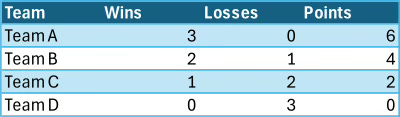
In mathematical terms, this is called a ‘transitive relation’ between the teams. In sporting terms, it’s called ‘the most tedious and unfunny thing you’d ever want to witness’. Awful, drab and dull. The Group of Death? More like The Group of Being Bored To Death. Avoid this group stage outcome at all costs.
The Strutting Peacock
Comedy Potential: 7/10

In this group stage outcome, we have one team (Team A) out in front, crushing everybody, while the other three teams take turns beating one another (Team B beats Team C, who beats Team D, who beats Team B).
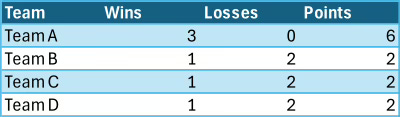
There’s some half-decent comic material to work with here, since only one of Team B, C or D can make the semi-finals, which will be based on net run rate. And most of the time that second-on-net-run-rate team will be decided by the team that got thrashed least by Team A. This is good gear. We’re bad, but we’re not quite as bad as you other two. Let us into the semi-finals.
The Hapless Donkey
Comedy Potential: 3/10

The opposite of The Strutting Peacock is The Hapless Donkey. In this group stage outcome, there’s one team (Team D) totally stinking up the place, losing to everybody, while the other three teams once again split victories and defeats evenly against one another (Team A beats Team B, who beats Team C, who beats Team A).
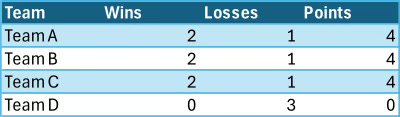
Looking at the broad similarities between The Strutting Peacock and The Hapless Donkey, you might be excused for thinking they have similar comic potential. But you’d be an idiot if you thought that. The difference here is that while two out of the top three sides will go through to the next stage, the team that misses out will tend to be the one who least bashes up poor old hapless donkey, Team D. ‘Oh, I see you’ve not been sufficiently ruthless against an outclassed opponent’ is a poor foundation for comedy.
The Futile David
Comedy Potential: 6/10

At first blush, you might think that The Futile David has little to offer, comedy-wise. Two clear-cut teams going through to the next stage. Two clear-cut teams missing out. What’s funny about that?
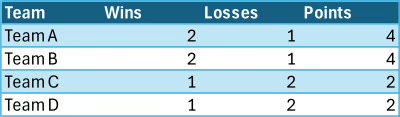
Well, let’s get out our humour shovels and dig a little deeper, shall we? Because consider how this outcome came about.
Let’s assume that Team A beat Team B in the match they played against one another. (If you don’t think they did, then change their labels. It really is that simple.)
Then, since Team B won two matches, they must have beaten both Teams C and D.
Now, let’s also assume that Team C won their match against Team D. Therefore, Team D lost to both Team B and Team C.
But, wait. Team D won one game. It follows, then, that they must have beaten Team A.
Ergo, what we have here is an Orderly Queue, in which Team A beats Team B beats Team C beats Team D. Except Team D has also inexplicably beaten Team A.
Team D is The Futile David, knocking over the Goliath that is Team A, saving us from an Orderly Queue, but not changing the overall group outcome. (Both Team A and Team B still go through.) Yes, it’s pointless comedy that accomplishes nothing (in this, it’s similar to, say, Last Week Tonight With John Oliver and other news satire programs). But pointless comedy is still comedy. And an upset that muddies up the godawful Orderly Queue group outcome is worth a few humour points, for sure.
Meta-Group A Outcome
Sadly, however, this is all very clear-cut, isn’t it? If we made these four group outcomes compete in a series of one-on-one comedy contests in some kind of meta-group, then that meta-group outcome would be, alas, an Orderly Queue.
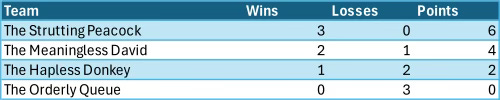
And, since I’ve already advised you to avoid this outcome at all costs, I have no choice but to end this initial analysis here.
(Tomorrow, however, we’re going to break down the comedy prospects of group stage outcomes when there’s not no ‘no results’ (ie, when there are some ‘no results’). Subscribe now to get that vital group stage outcome comedy ranking update straight to your email inbox.)
