
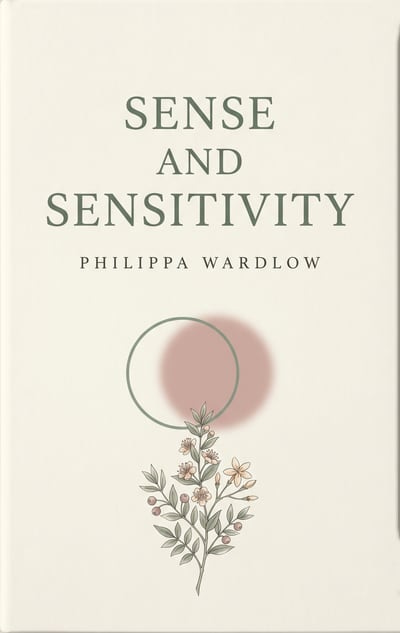
Sense and Sensitivity Philippa Wardlow Caldwell & Son | 2022 | 434pp
Elinor Dashwood is practical, composed, and committed to only ever unpacking her feelings in a mutually agreed therapeutic framework. Marianne Dashwood is passionate, impulsive, and maintains a fully transparent emotional disclosure policy. Set in the drawing rooms and unmediated countryside of Regency England, this is a novel about propriety, passion, and the importance of checking in.
★★★★ Austen with better boundary-setting. An unqualified triumph.
There is a school of thought - increasingly well-credentialled - that what Jane Austen most needed was a more robust framework for consent. Philippa Wardlow has clearly attended that school and graduated with distinction, taking the Austen template and quietly correcting it. Sense and Sensitivity is set firmly in the Regency period: the bonnets are present, the entailments are vexing, the pianoforte is in regular use. What exists alongside all of this, however, woven into the social fabric as though it had always been there, is a more contemporary expectation. Namely, that one does not pursue a romantic attachment without first establishing where both parties are, emotionally, giving due consideration to any relevant constraints on their interpersonal bandwidth. The result is Austen, but improved. It is difficult to overstate what a relief this is.
Wardlow’s upgraded version of Elinor Dashwood is the novel’s great achievement. Her composure, long misread by critics as emotional suppression, is here correctly identified as a principled commitment to deferred inner processing, on her own terms. When Edward Ferrars finally declares himself in Chapter Nineteen, Elinor asks for twenty-four hours before responding - citing a prior commitment and a need to ‘sit with this’ - and the scene is precisely the kind of considered, boundaried exchange for which this novel argues. Colonel Brandon, for his part, is repositioned as a cis man who has clearly done the work - textbook INFJ, with the empathy and active listening skills that implies.
The minor characters are handled with similar deftness. Mrs. Jennings, traditionally a figure of comic intrusion, here arrives with the emotional literacy to read the room, and the maturity to act on it. Willoughby’s arc acknowledges his own avoidant tendencies too late to repair the harm he has caused, but not, Wardlow seems to suggest, too late for meaningful reflection and measurable personal growth. Robert Ferrars, sadly, remains a high-functioning solipsist nightmare, and while one accepts that certain characters resist rehabilitation on narrative grounds, a trigger warning would not have gone amiss.
This, however, is a minor quibble in a novel that otherwise rectifies the outdated missteps that have heretofore prevented so many contemporary readers from enjoying Austen.
About the Author
Philippa Wardlow is the author of The Middlemarch Situation and A Tolerable Fortune. They are currently at work on a revised Brontë and what their publisher describes as a thorough reconsideration of Dickens’ ‘fucked up class politics’.
Who Is This Book For?
Those readers who have always wondered what Jane Austen might have accomplished with her stories had she simply known better
About time Dickens was updated, too! I'm holding out for the version of Oliver Twist in which Oliver leads a revolution, rallying the street boys and upending the entire workhouse system, instead of being bribed off by deus ex machina benefactor and some ridiculous medallion business.
Fagin is cancelled for his support of Israeli war machine, rather than the current thing - being a target of antisemitic abuse and harshly treated by getting executed for being an accessory to murder after the fact and receiving stolen goods (like, c'mon, justice system, jeez!)