
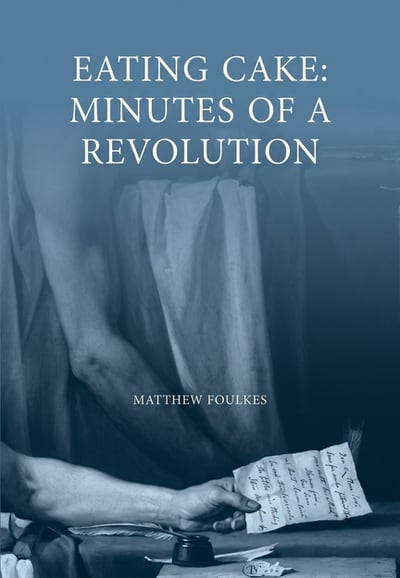
Eating Cake: Minutes of a Revolution Matthew Foulkes Harwick Publishing | 2026 | 912pp
Paris, 1792. The Revolution devours its children. Geneviève Aubert, Secretary to the Committee of Public Safety, records everything. It’s a piece of cake.
★½ Minutes have never felt so long
Matthew Foulkes’ debut arrives trailing considerable expectation - his short fiction has appeared in such prestigious periodicals as Annals & Fictions, Remnants and Quarterly Letters of New Albion and this novel was longlisted for the Edward Gibbon Prize before publication, a distinction that felt, in retrospect, like a warning. The premise of Eating Cake is sound: the French Revolution rendered entirely through the minutes of its committees, as recorded by the fictional Geneviève Aubert - a woman who blends the important qualities of clerical exactitude, mild civic optimism and period accurate hair braiding. The procedural texture of revolutionary Paris is further rendered with genuine authority, and the minutes themselves - their conflict of interest disclosures, their quorum requirements, their matters arising - are entirely convincing.
Unfortunately, Foulkes asks us to spend 912 pages with a woman whose inner life is, by the novel’s own structural logic, permanently offscreen. Epistolary and documentary novels have long demonstrated that constraint can generate intimacy. Alas, any intimacy the character of Geneviève might engender in a reader tends closer to that of a teenage boy with a Sydney Sweeney screencap - unearned, conjured from soulless surface impressions, and culminating in something extraordinarily messy and difficult to explain.
Worse still, the novel cannot even offer something akin to those hypothetical adolescents’ moment, however brief, of uncomplicated pleasure. Geneviève records the death of colleagues, the fall of governments, the restructuring of an entire civilisation, and the reader experiences something close to administrative detachment. The novel accumulates substantial knowledge of Geneviève’s filing system and her precise penmanship, but almost none of Geneviève herself. This might be a deliberate formal statement about the erasure of women from the historical record. If so, it is a theme well masked.
Foulkes is clearly a writer of considerable technical ability, which makes Eating Cake all the more dispiriting. The research is impeccable. The commitment is total. But if there is a character worth knowing inside this meticulously minuted novel, she has submitted her apologies for absence and will not be attending.
About the Author
Matthew Foulkes is a former parliamentary records officer and the author of numerous short stories including The Action Items of Agincourt and Any Other Business at The Battle of the Bulge. Eating Cake is his first novel and, one hopes, a transitional work.
Who Is This Book For?
For those who enjoy the sensation of reading without the inconvenience of feeling anything.
Hmm, I don't know, I reckon this could actually possibly work, if given the right angle. Maybe some margin notes on the minutes by the Secretary and others that could be played to comedic and/or tragic (or better yet, tragicomic) effect. Maybe put in a bit of alternative history in there, like introduce a curveball/hitherto unknown-yet-plausible historical fact into the motivations of committee members. Obviously the fact that one can highlight the coldness and remove of the minutes from the human tragedies that's resulting from the meetings being recorded by same. Definite potential :)